Top 5 AI Voice Agents with Telephony Support
Feb 28, 2026


Most businesses have quietly made peace with the bad phone call. The one where the customer waits, presses numbers that lead nowhere, gets transferred to someone who cannot help, and eventually hangs up, having accomplished nothing. It happens millions of times a day, and it keeps happening because the organizations running these systems have decided it is simply the cost of operating at scale.
It is not. It is a choice, and in 2026, it is an increasingly hard one to justify. AI phone agents have crossed the threshold where the technology is no longer the limiting factor. The speech recognition is accurate enough, the language models are capable enough, and the voice synthesis is natural enough. What separates a voice AI deployment that actually works from one that does not is whether the platform underneath it was built specifically for phone calls or just adapted to handle them. Those two things look identical on a features page and feel completely different on a live call. The five platforms below were built for it.
1. Fish Audio
Voice quality in telephony is not an aesthetic preference. It is the entire medium. When a caller cannot see you, read your expression, or judge your intent from anything other than sound, the voice doing the talking carries a weight that most platform comparisons quietly undervalue. Fish Audio takes that weight seriously, and it becomes obvious the moment you hear the output.
The S1 model was trained on over 700,000 hours of multilingual audio, and the result is not just accurate speech. It sounds like it belongs to someone. Natural pacing, the kind of slight variation in emphasis that real people use without thinking, is the emotional texture that shifts based on what the conversation actually calls for. The platform supports 48-plus distinct emotional expressions because a voice agent talking to a confused customer through a billing dispute and one confirming a delivery time with an excited new buyer genuinely should not sound identical. Most platforms do not make that distinction; Fish Audio does.
For live phone calls, the platform streams at sub-500ms first-byte latency, which is fast enough that callers do not register a pause between speaking and being heard. Silence on a phone call communicates something, and what it communicates is that the system is struggling. Eliminating that pause changes the entire feel of the conversation in ways that are hard to articulate but immediately felt. Fish Audio also builds and deploys cloned voice personas from as little as 10 seconds of reference audio, holding them consistently across languages, regions, and time of day. For any brand that has thought carefully about how it sounds to customers, that kind of consistency is genuinely hard to find elsewhere.
2. ElevenLabs
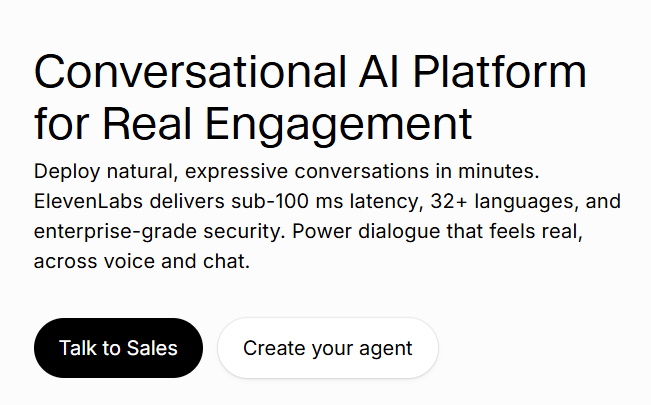
ElevenLabs made its name on synthesis quality, and that reputation is deserved. The more interesting story in 2026 is what the platform has become beyond its role as a synthesis platform. The Conversational AI suite is now a full end-to-end stack for voice AI phone calls, covering agent logic, knowledge base integration, LLM selection, and telephony delivery. For most teams, the question is no longer how to wire ElevenLabs into a custom pipeline but whether the pipeline ElevenLabs has already built is the one they want to use.
The case for it starts with speed. The Flash v2.5 model generates voice output in under 75ms, which effectively removes synthesis latency as a variable in conversation quality. What the caller notices is not the technology running underneath. They just notice that the conversation moves. Pair that with voice quality holding up across 32 languages, and you have a platform that handles global deployments without losing the standard that makes ElevenLabs worth using in the first place.
The voice cloning is worth understanding properly because it works differently from what most people expect. A cloned voice on ElevenLabs does not just approximate the phonetics of the original speaker. It keeps the accent, the cadence, the small speech habits that make a voice feel like a specific person rather than a generic AI register. That persona carries across languages too, so a caller in Mexico City and a caller in Frankfurt both hear the same brand voice, just in their own language. For companies that have put real thought into their brand presence on the phone, achieving that kind of coherence was genuinely difficult even two years ago. ElevenLabs is also HIPAA-compliant for enterprise plans, removing common blockers for healthcare and financial services teams.
3. Retell AI
Retell tends to come up in a specific kind of conversation. The one where a team has already tried something else, hit a wall, and started asking more precise questions about what they actually need. Its advantages are the kind you only fully appreciate once you know what problems you are trying to solve. End-to-end response latency runs around 600ms in production, which matters less as a number and more as proof of architecture. Achieving that consistently requires treating transcription, LLM inference, synthesis, and audio delivery as a unified pipeline rather than a chain of separate services. Most platforms do not do this, and you feel the difference on a call. You also feel how Retell handles interruptions. Real callers do not wait politely for an agent to finish before responding. They cut in, backtrack, and change direction mid-sentence. A voice agent that loses its place every time this happens will feel robotic, regardless of how natural the voice sounds. Retell manages these moments cleanly enough that the mechanics of the system stop being noticeable, which is exactly where they should be.
The telephony layer is genuinely native rather than integrated post facto. SIP trunking, DTMF capture, IVR navigation, warm transfers with custom whisper messages, and verified caller IDs that improve answer rates on outbound calls. These are the features that surface as requirements after a team runs its first real deployment, and Retell already built them. The platform is SOC 2 Type II-, HIPAA-, and GDPR-compliant across all plans, not just enterprise tiers, which means organizations in healthcare, insurance, and financial services do not have to negotiate compliance as a separate line item. The pricing at $0.07 per minute is transparent in a category where opacity is more the rule than the exception.

4. Vapi
Vapi is the platform for teams who already know exactly what they want to build and need infrastructure that will not limit them as they build it. Every component in a Vapi deployment is independently replaceable. The transcription engine, the language model, the voice synthesis provider, and the telephony layer. Swapping one does not require rebuilding the rest. For engineering teams with specific requirements, a particular LLM already fine-tuned for their domain or a synthesis voice they have tested extensively, that flexibility is not incidental. It is the reason they chose Vapi over everything else.
The tool-calling capability is where that architectural choice pays off most clearly in production. A voice-only AI agent running on Vapi can pull a customer record mid-conversation, check availability in a connected calendar, trigger a webhook to update a CRM field, or query a product database while the caller is still talking. The mechanics are invisible. From the caller's perspective, they asked a question and got an answer. The fact that the agent performed several API calls to produce that answer is completely transparent to them, which is exactly how it should be.
Vapi is not the right starting point for teams that want to move quickly without engineering investment. The pricing covers hosting, transcription, synthesis, and telephony separately, which rewards careful planning. But for teams that have done that thinking and need to build something that does not fit neatly into a pre-packaged product, there is more ceiling here than on almost anything else in this category.
5. Poly AI
The phone channel at enterprise scale is a different problem than the phone channel for a mid-sized business. The volume is different, the stakes are different, the organizational complexity is different, and the consequences of a system that performs inconsistently are measured in ways that do not appear on a feature comparison. PolyAI was designed for that version of the problem, and it shows in how the platform thinks about its work.
The differentiator that matters most is where the models came from. PolyAI's speech and language understanding was trained on actual phone call audio, not web text or studio recordings. The real acoustic environment of compressed telephone calls, with background noise, regional accents, people talking over each other, and sentences that trail off before they finish. Models trained on cleaner data tend to perform well in demos and degrade in the conditions that make enterprise telephony genuinely hard. PolyAI holds up because its training reflects where it is actually deployed.
Conclusion
The operational features reflect how large contact centers work in practice. Warm transfers carry context, so the receiving agent does not start from zero. Escalation logic hands off at the right moment without the caller feeling abandoned. Analytics break performance down by call type, language, sentiment, and resolution rate, giving operations teams real visibility rather than aggregate numbers that hide where the work still needs to be done. PolyAI co-creates the voice persona with its clients rather than offering self-serve configuration, which trades direct control for a higher quality baseline from the first deployment. Pricing starts around $150,000 per year. For the organizations PolyAI serves, the question is rarely whether that investment is justified. It is whether the performance holds at the volume they need.