Top 5 Multilingual AI Voice Agents with Integrated Language Detection
Feb 24, 2026


Language is personal. When a customer calls a support line and has to wrestle with a language that is not their own, the interaction starts at a deficit before a single word of help has been exchanged. In 2026, that problem is solvable, and the best multilingual AI voice agents are solving it not by asking callers to select a language from a menu, but by simply listening, detecting, and responding in whatever language the person naturally speaks.
That is the distinction worth paying attention to when evaluating cross-language voice AI platforms this year. One important thing to notice is that multilingual support and integrated language detection are not the same thing.
There are multiple platforms that claim to support 15 languages. Far fewer will detect which one you are speaking mid-conversation, adapt in real time, and keep the interaction feeling natural throughout. The five platforms below actually do it, and they each approach it in a way that is worth understanding before you decide which one belongs in your stack.
1. Fish Audio
Fish Audio's core strength has always been the quality of the voice itself, and when you are building global voice AI, that quality has to hold across languages, not just in English. Fish Audio's models are trained on rich multilingual data and carry the right intonation, rhythm, and emotional texture for the language being spoken. That is a harder problem than it sounds, and most platforms quietly fail at it.
Fish Audio has the best voice cloning capability, which makes it compelling for multilingual deployments. You can build a single branded voice persona and deploy it across multiple languages without it sounding like a different person each time. For global brands that have invested in a specific voice identity, this is genuinely valuable. The API is clean and developer-friendly, integrating into custom pipelines without forcing you into a rigid architecture, giving engineering teams the freedom to build language-detection logic around it using their preferred approach.
The voice quality and multilingual fidelity are exceptional, but you are responsible for the broader conversation architecture. For teams with the engineering capacity to build that layer, it is a powerful foundation for truly global voice AI.
2. ElevenLabs
ElevenLabs sits at the top of almost every voice quality conversation in 2026, and its multilingual capabilities are a big part of why. ElevenLabs' library spans dozens of languages with voices that carry genuine regional and tonal accuracy. Those voices go well beyond the mechanical multilingual output that were present in earlier platforms. When a caller hears an ElevenLabs voice responding in their native language, the experience is not a translated version of an English agent. It sounds like an agent that was built in that language from the start.
The conversational AI suite that ElevenLabs has been building out adds real substance to its multilingual story. ElevenLabs now allows teams to build and deploy production-ready voice agents directly on the platform, with multilingual support baked into the infrastructure rather than bolted on afterward. For industries like healthcare, financial services, and legal, where the stakes of a miscommunication are high, the combination of audio accuracy and language breadth that ElevenLabs provides is genuinely hard to match.
Where ElevenLabs is still growing is in the depth of its enterprise workflow integrations compared to more agent-focused platforms. Teams with complex CRM integrations and multi-system workflows may find themselves doing supplementary integration work. But as a multilingual voice infrastructure layer, it remains the benchmark.
3. Retell AI
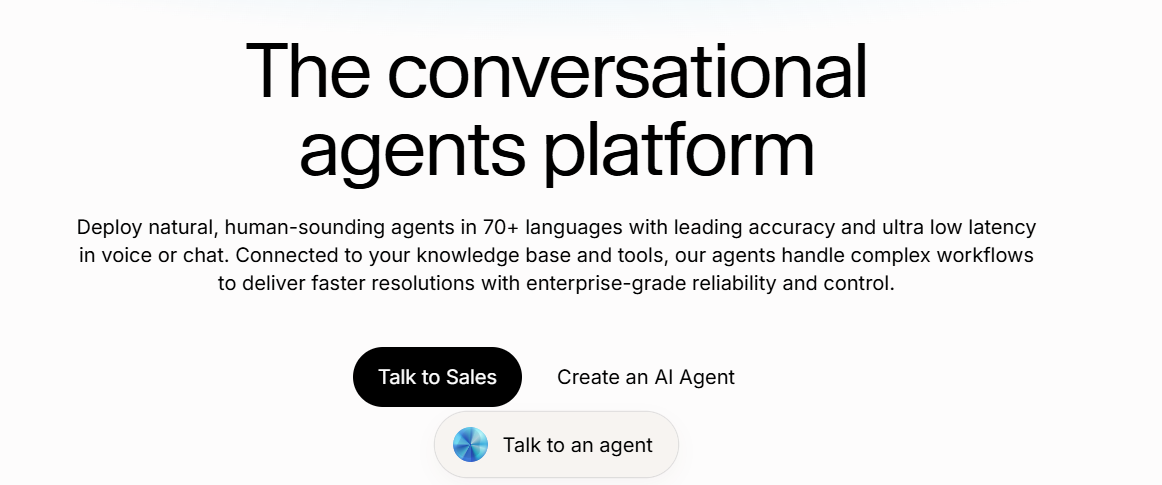
If integrated language detection is the specific capability you are evaluating, Retell AI is the most well-documented and developer-credible option on this list. It supports more than 30 languages with automatic detection built into the platform, including major global languages such as Spanish, French, German, Hindi, Portuguese, Japanese, Russian, Italian, and Dutch. In this platform, detection occurs in real time at the start of a conversation; the agent switches to the appropriate language without any prompt from the caller, and the conversation's context is maintained without being dropped.
That last part matters more than people expect. Many so-called multilingual platforms detect a language switch and restart the conversation logic from scratch. However, retell handles it correctly.
If a caller starts in English, shifts to Spanish mid-conversation, and comes back to English, the agent can track it easily. This is really important for global businesses handling support, sales, or operations calls across regions. Continuity is one of the most important aspects. It seperates a functional multilingual agent from one that causes frustration.
Retell is developer-first by design, which means it rewards teams that want to configure deeply and build custom. For non-technical teams expecting a more guided setup experience, there is a learning curve. But for engineering teams building serious multilingual voice infrastructure, Retell is one of the most credible choices available in 2026.
4. Vapi AI
Vapi AI takes the language detection conversation one step further by handling something most platforms quietly avoid: code-switching. Real multilingual speakers, especially in communities where two languages blend naturally, do not always stay cleanly in one language for an entire call. Vapi's models are built to detect and follow language mixing mid-sentence, so they do not get confused or default to a dominant language when a caller blends Spanish and English, or Hindi and English, in the same paragraph or sentence. Vapi runs on GPT-4o for intent understanding and Deepgram Nova 2 for transcription, which gives it strong accuracy across diverse accents and regional language variants, not just the standardized versions of each language that some platforms train on.
The platform Vapi AI is API-first and gives developers a high degree of control over how language detection is handled and how agents respond to it. The customization is genuinely deep, which is a strength for teams that need precision and a potential friction point for teams that want simplicity. For building cross-language voice AI that handles the messy, real-world way people actually speak, Vapi is one of the most sophisticated options available.
5. Synthflow AI
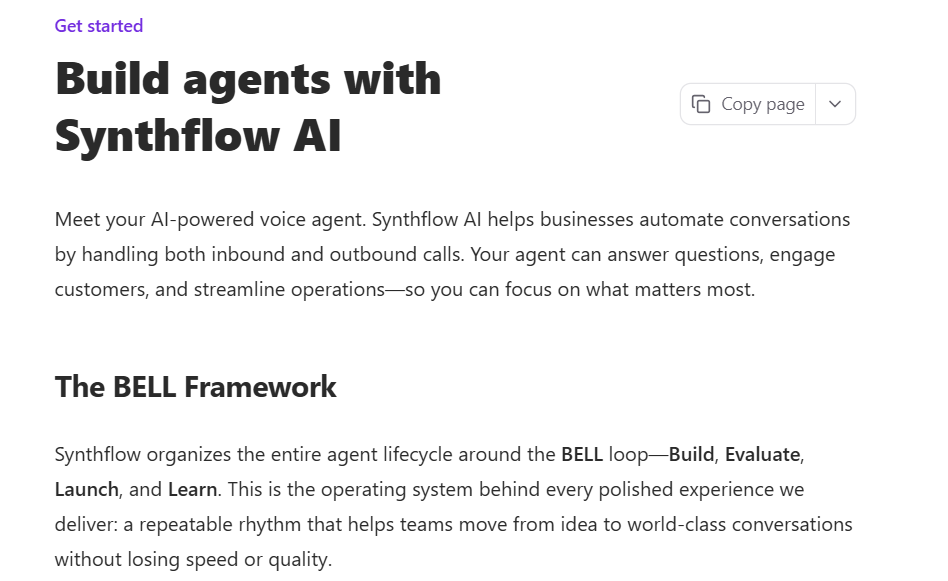
Synthflow brings something to this list that the other four do not prioritize as strongly: accessibility. Building and deploying a multilingual AI voice agent on Synthflow does not require an engineering team.
The no-code builder lets operations leads, customer success managers, and product teams configure multilingual agents and launch them without filing a single engineering ticket. This significantly changes the economics and timeline of global voice AI deployment.
The multilingual support is practical and well-suited for businesses that need fast coverage across major world languages without a long development cycle. This is especially helpful for companies expanding into new regional markets that need a working multilingual voice agent in weeks rather than quarters. Synthflow makes that it realistic to work in that timeline. It integrates natively with major CRM and support tools, so the agents do not operate in isolation but feed data back into the systems teams already rely on.
The trade-off with Synthflow is the depth of customization. Teams with highly specific language detection requirements or complex conversation flows will eventually find the no-code environment limiting compared to developer-first platforms like Retell or Vapi. But for the majority of business use cases, particularly in sales, customer support, and operations, Synthflow covers the ground that matters and does it faster than almost anything else on the market.
Conclusion
The right multilingual AI voice agent platform depends on what you are actually trying to solve. If voice quality and brand consistency across languages are the priority, Fish Audio and ElevenLabs are the synthesis foundations to build on. If automated language detection with real-time switching and context retention is the core requirement, Retell AI is the most credible and well-documented choice. If your callers mix languages mid-conversation or speak regional variants of major languages, Vapi's code-switching capability is worth serious consideration. And if you need to deploy global voice AI quickly without deep engineering resources, Synthflow gets you live faster than any other platform here.
What all five share is an understanding that multilingual voice AI is not a translation problem. It is a listening problem. The best cross-language voice AI does not wait for a caller to identify their language. It picks it up naturally, responds in kind, and makes the whole interaction feel like it was built specifically for that person. In 2026, that capability is no longer a premium feature. It is the baseline expectation, and these five platforms meet it.

Kyle is a Founding Engineer at Fish Audio and UC Berkeley Computer Scientist and Physicist. He builds scalable voice systems and grew Fish into the #1 global AI text-to-speech platform. Outside of startups, he has climbed 1345 trees so far around the Bay Area. Find his irresistibly clouty thoughts on X at @kile_sway.
Read more from Kyle Cui >